
Why I’m Leaving Spotify

Around 2012 I attended a songwriter showcase in Denver featuring Joe Pug. To this day he is one of my favorite songwriters. I remember him talking about how he got his start in the early aughts by driving town to town, playing small venues, and selling records out of the back of his car, and I thought: I can do that. In fact, I’d love to do that. I briefly had the chance, only I didn’t have any music to promote at the time. Nevertheless, I had one of the most memorable trips of my life. By the time I was producing and promoting my own music the landscape of the industry had changed—you couldn’t drive it all with a trunk full of records, not to mention the fact that no one was buying records anymore—it was the beginning of streaming and the height of social media, and independent musicians were suddenly pressured to shift their goals from forging personal connections in venues to going viral online, from selling records to promoting our music on playlists, and we all had our eyes on Spotify.


(3 of the few snapshots I have from that first tour/trip with Christopher Robin Donaldson—the third is me mid-flip into a natural pool off the Colorado River—they are among my fondest memories ↑)
It was the same year that I downloaded the app and at the time I loved it. I discovered some of my favorite music through Spotify’s (early) algorithms. And eventually, my songs got placed on a few playlists that opened them up to listeners in unexpected places around the world. Spotify is still a powerful tool, especially for independent musicians, and I am not arguing for them to leave the app, but I want to tell why I am.
Now, almost fifteen years later, the app is bigger than ever, with 713 million global users, holding double the market share of the runner up (Apple Music), and its year-end “Spotify Wrapped” seems to drown out everything else come December. One way that it’s grown as such is by changing its algorithms. In Kyle Chayka’s 2024 New Yorker article, “Why I Finally Quit Spotify,” he writes that with the latest update, “it became clearer than ever what the app has been pushing me to do: listen to what it suggests, not choose music on my own.” (Have you noticed it too? I certainly have.) And that’s only the beginning. Spotify has opened the floodgates to AI-generated music and has become filled with bots.
You may be thinking: So has everywhere else. This is how the big tech platforms do it. And, generally speaking, you’re not wrong. But it matters when it comes to music streaming because Spotify makes the numbers public (as does YouTube Music which I’ve never used directly), creating an incentive for people to use AI, bots, and all sorts of other resources from honest promotion to plain old cheating to boost their numbers.
An experiment: look up your favorite artist’s top song on Spotify, then on another platform like Apple Music. There is a strong chance that it’s not the same. Because Spotify shows the numbers, musicians (and their teams) are incentivized to invest in boosting the numbers of whatever song they’re promoting. Now a whole new economy has emerged to help them, and with it, tons of scams.
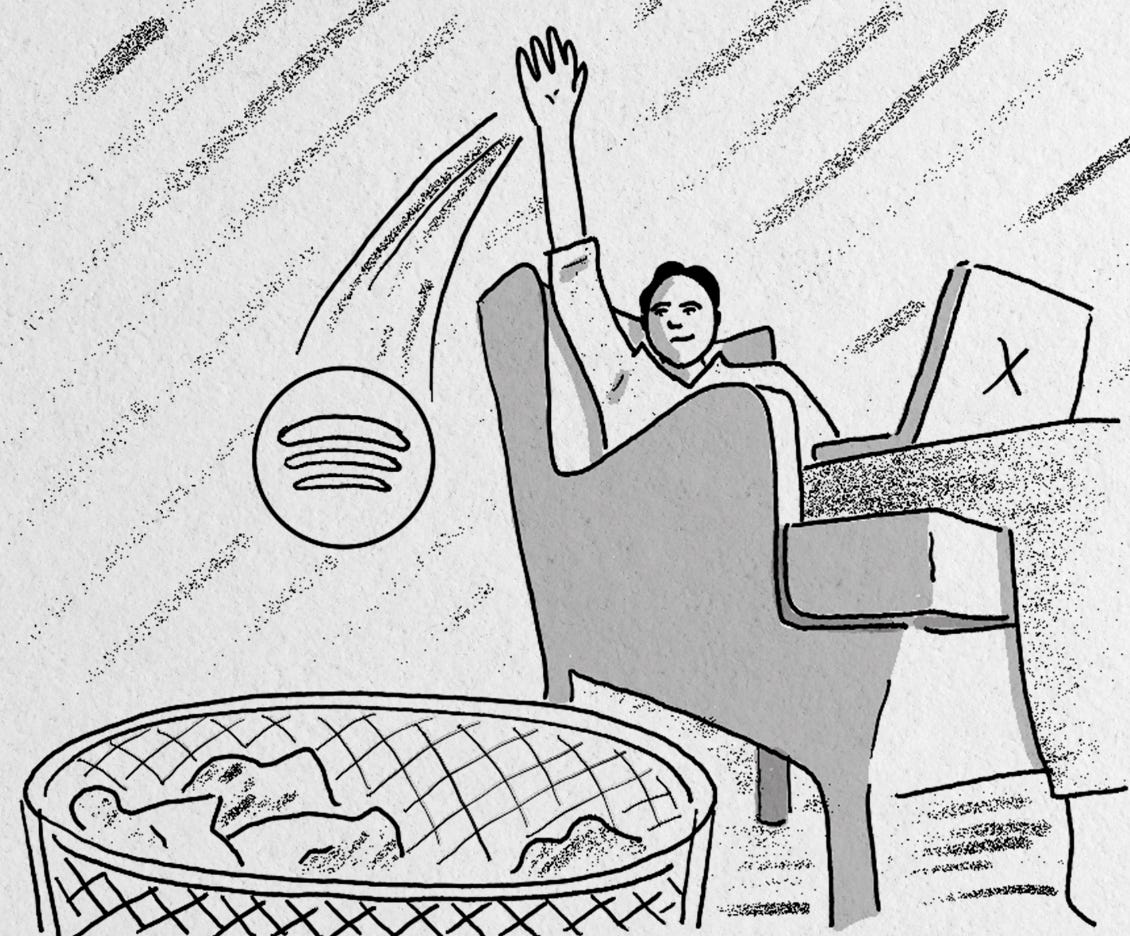
(Sketch by yours truly ↑)
In my time as an artist on Spotify, I’ve been scammed once and unfairly accused of scamming once. After the release of my second album, I became aware of the world of online playlist promoters: in some cases, individuals and firms, but also automated platforms dedicated to matching your songs with playlists, and thus, listeners. At first, they were relatively affordable, even for a barista-by-day/songwriter-by-night like me, and they proved to work well. (I have never made music meant to “go viral” and so I relied on such platforms to reach people.)
By the release of my next single, the cost had more than doubled. Independent musicians like myself could hardly keep up, and still can’t. I needed a cheaper option, found one of many that had sprung up, and after vetting them, payed their fee. For a while, they appeared to be completely above board and worked well. However, I soon got notice from Spotify that my song had been streamed by too many bots. I was accused of having tried to cheat the system despite being cheated myself, and my song was taken down. When you’re a small independent artist and this happens to you, there is nobody at Spotify to call (let alone my—and most—online distributors).
And so, I went back to my original, trusted, and more expensive option, only to be accused again. While in the first case, the shady promoter’s scheme would later come to light, the second situation still seems to be a case in which my song got swept up along with others despite trying to play fair.
This obviously doesn’t happen to artists with larger followings who generate enough profit for the platforms to make the bot streams negligible. (I also imagine there is someone at Spotify to pick up the phone for their managers). But for the independent artist trying to get a foothold while making $0.003 cents per stream after investing hundreds in promotion, not to mention distribution (and recording the song)—if not more—this can be devastating. We are then forced to start the process over, paying again to have our music redistributed on the biggest most influential platform.
And why not start there? With how little we’re paid. The next biggest platform pays $0.007 cents per stream, and after that it drops to $0.001 with a few niche exceptions like Napster that pays up to $0.019. For me, this isn’t about making money from streaming, though that should be reason enough.
I can already hear my detractors, and part of me too, firing back: But these platforms have helped independent artists reach larger audiences than ever before. True. But they’ve also bulldozed the other paths laid down before their take over. And while some artists are able to use the system despite how it uses us to make a living, I think we can all agree that there must be a better system for us all.
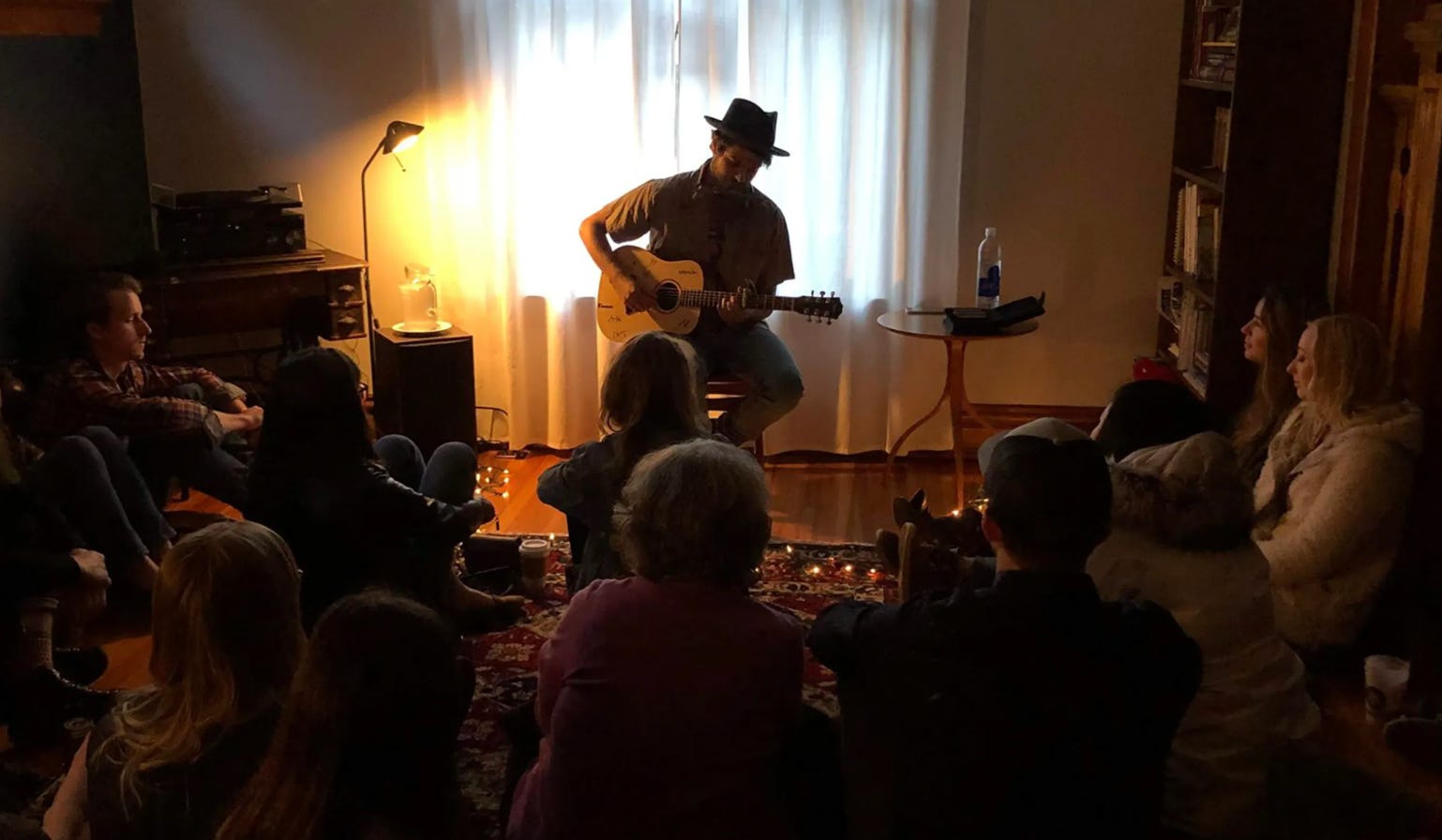
Why I’m leaving now comes back to connecting with listeners. I’m tired of playing this game, when I really want to be driving town to town, playing small venues, and selling records out of the back of my car.
(Having experiences like this ↓)
There are plenty of even better reasons to leave Spotify. Until last month, they were running recruitment ads for ICE, while Spotify CEO Daniel Ek uses his fortune to invest in an “AI defense” startup, and is the chairman of Helsing, an AI software company that manufactures military drones. In August Brown’s Los Angeles Times article, “Spotify boycott: Artists leave ‘garbage hole’ platform after CEO invests in AI weapons,” he tracks a “small exodus” of prominent musicians leaving the platform in protest. For indie artists who rely on Spotify, this is, needless to say, much riskier. In all cases, those that leave, already have established audiences that will leave too, at least to stream their music. I am in neither camp, and I recognize that I make my decision to leave from the privileged position of having another creative outlet with which I make my living.
If I was only a consumer, I would have left Spotify long ago for these reasons, and surely other major streaming platforms for similar ones. The same can be said of most social media platforms (but that deserves a post of its own). As an artist, I’m finally ready. I’ve realigned my goals with the kind of music career I want to have: a smaller one, rooted in community, that I can build on my own terms.
I’ve begun the process this week which will take about 30 days. Beyond that, I hope to see new disruption in the industry soon that recenters artists, allowing us to thrive, as well as fans, allowing us to discover music that expands our listening experience. Till then, you can find me on Bandcamp, and maybe in the parking lot behind a small venue in your town.
Love this piece! I've been troubled by my continuing Spotify enrollment for all the reasons you name and this week I finally took the plunge. Thanks for the encouragement and your clearheaded but still passionate stance that gave me the push I needed.
Fantastic piece! I switched away from Spotify two years ago and never looked back. Though I still miss their UI, their business practices were just icky and have only gotten worse.